
Main Courses
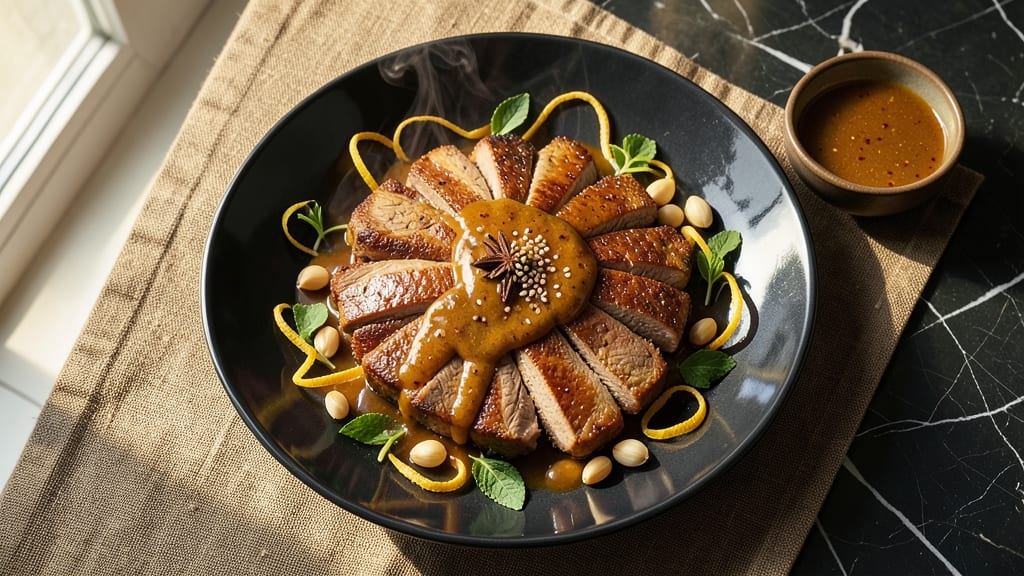
This braised pork loin Chinese recipe transforms simple ingredients into a dish that carries the warmth of a bustling Cantonese kitchen. The secret lies in the five-spice powder's aromatic glow and celery's crisp crown that cuts through the rich, caramelized sauce.
I developed this technique during my apprenticeship in Charleston, where I learned how slow braising unlocks pork's natural tenderness while building deep, complex flavors.
The process begins with velveting the pork loin—marinating it in a mixture of cornstarch and egg whites to create an ultra-tender texture. This method, combined with a fragrant base of ginger, garlic, and star anise, ensures every bite delivers both depth and harmony.
The braising liquid, infused with soy sauce and Shaoxing wine, reduces to a glossy finish that clings perfectly to the meat.
What emerges is a dish where the pork falls apart at the touch of a fork, its surface glistening with a caramelized sheen. The celery crown adds a satisfying crunch that contrasts beautifully with the meat's velvety texture.
Serve it over steamed jasmine rice or alongside stir-fried bok choy for a complete meal that feels both comforting and sophisticated.
This recipe is perfect for special occasions or when you want to impress guests with authentic Chinese flavors that don't require hours of prep. The key is patience—the slow braising transforms tough cuts into something luxurious.
Let's create this dish that carries the essence of Chinese home cooking right to your table.
Ingredients for braised pork loin chinese
Simple ingredients that transform into a dish with restaurant-quality depth and texture.
| Ingredient | Amount | Notes |
|---|---|---|
| Pork Loin 🐖 | 1 ½ lb | Center-cut, boneless, 1-inch thick |
| All-Purpose Flour 🌾 | ¼ cup | For velveting mixture |
| Large Eggs 🥚 | 2 whole | Beaten for velveting |
| Five-Spice Powder 🌶️ | 1 tbsp | Authentic Chinese blend |
| Fresh Ginger 🧄 | 1 tbsp | Minced, peel included |
| Garlic Cloves 🧄 | 4 cloves | Minced, peeled |
| Star Anise 🌟 | 2 whole | Lightly crushed |
| Celery Stems 🧅 | 4 whole | Cut into 2-inch crowns |
| Light Soy Sauce 🥄 | ½ cup | Kikkoman preferred |
| Shaoxing Wine 🍷 | ¼ cup | Or dry sherry substitute |
| Brown Sugar 🍯 | 2 tbsp | Packed, light variety |
| Water 💧 | 1 ½ cups | Room temperature |
| Cornstarch 🌾 | 1 tbsp | For velveting mixture |
| Vegetable Oil 🫒 | 2 tbsp | High smoke point |
| Salt 🧂 | 1 tsp | Kosher or sea salt |
The pork loin is the foundation—look for a center-cut piece with visible marbling for tenderness. Local butchers often carry better cuts than grocery stores, and asking for a 1-inch thick slice ensures even cooking. Five-spice powder is non-negotiable here; Penzeys or Spicewalla carry authentic blends, but the bulk section at Whole Foods works too. Fresh ginger and garlic should smell vibrant, not dried out—Asian markets usually have the freshest. Celery crowns add that signature crunch, so choose firm, crisp stalks with no brown spots. Shaoxing wine can be hard to find, but dry sherry makes a solid substitute.
No five-spice powder? Combine 1 tsp cinnamon, 1 tsp fennel seeds, 0.5 tsp cloves, 0.5 tsp nutmeg, and 0.5 tsp black pepper for a close approximation. Running short on Shaoxing wine? Dry white wine or extra soy sauce bridges the flavor gap. The cornstarch and egg whites create the velveting effect—don't skip this step, as it's what makes the pork melt-in-your-mouth tender. For the celery, if you can't find thick stalks, substitute with fennel bulbs cut into thick slices. Brown sugar adds depth, but honey or maple syrup work in a pinch if you're avoiding refined sugar.
Prep ahead by velveting the pork up to 24 hours in advance—it keeps well in the fridge. The braising liquid can be made a day ahead and reheated gently. Store leftovers in an airtight container for up to 4 days, though it reheats beautifully and tastes even better the next day. For serving, keep the celery crowns separate until ready to plate—they lose crispness quickly. This dish freezes well for 3 months if you want to make a big batch for entertaining.
Why You'll Love This Recipe
- No-Fuss Prep: I swear by this—just coat the pork in flour, dip it in beaten eggs, and let the five-spice powder work its magic. No fancy knife skills or last-minute shopping runs here.
- Deep Umami Magic: That slow braise? It transforms tough pork into melt-in-your-mouth perfection, with ginger and five-spice giving it a warmth that lingers. Honestly, it’s the kind of flavor that makes you want to eat it straight from the pan.
- Leftover Goldmine: This dish tastes even better the next day—yes, really. I make a double batch on Sundays, and it’s still my go-to for quick lunches or late-night cravings. The sauce thickens up just right, so every bite is rich and satisfying.
- Budget-Friendly Feast: Pork loin stretches far, and the ingredients won’t break the bank. Between us, this is my secret weapon for feeding the whole family without stressing over the grocery bill. Plus, the eggs and flour are pantry staples, so you’re already set.
Step-by-step instructions for braised pork loin Chinese recipe
Master this two-stage velveting technique for tender, aromatic pork with a glossy five-spice crust.
Prepare the Velveting Mixture
In a shallow dish, combine the 0.25 cup all-purpose flour, 1 tbsp cornstarch, and 1 tsp salt. In a separate bowl, beat the 2 whole large eggs until frothy but not fully emulsified. Whisk the flour mixture into the eggs until smooth—this creates the velveting slurry that will seal in pork juices.
Add 1 tbsp five-spice powder and 1 tbsp minced fresh ginger to the slurry. The five-spice adds depth while the ginger prevents bitterness. Mix until evenly distributed, then set aside. This mixture will transform your pork from tough to silky in minutes.
Velvet the Pork in Two Stages
Pat the 1.5 lb pork loin dry with paper towels—moisture is the enemy of proper velveting. Working in batches to avoid overcrowding, dip each side of the pork into the egg mixture, coating it completely. Let it sit for 10 seconds before transferring to a clean plate.
Heat 1 tbsp vegetable oil in a nonstick skillet over medium heat. Add the coated pork and sear for 2-3 minutes per side until golden brown. The exterior should develop a thin crust while remaining tender inside. Remove and set aside—this first sear locks in flavors before the second velveting stage.
Return the skillet to medium heat and add the remaining 1 tbsp vegetable oil. Return the pork to the pan and cook for another 1-2 minutes per side until the exterior is lightly browned again. This double velveting ensures maximum tenderness while developing a subtle crust.
Braise with Aromatics and Celery Crowns
In a Dutch oven or heavy pot, combine 4 whole celery stems cut into 2-inch crowns, 4 cloves minced garlic, 2 lightly crushed star anise, 0.5 cup light soy sauce, 0.25 cup shaoxing wine, 2 tbsp brown sugar, and 1.5 cups water. Bring to a simmer over medium-high heat until the liquid reduces slightly and aromatics are fragrant.
Add the seared pork to the pot, turning to coat in the sauce. The pork should be mostly submerged—if not, add ½ cup water. Bring to a gentle boil, then reduce heat to low, cover, and simmer for 1 hour 15 minutes. The pork is done when it reaches 203°F internally and pulls apart easily with a fork.
Finish and Rest for Maximum Tenderness
Remove the pork and let it rest on a cutting board for 10 minutes before slicing. This resting period allows juices to redistribute, ensuring each bite is moist. Skim any excess fat from the braising liquid, then return the pork to the pot and simmer uncovered for 5 minutes to thicken the sauce slightly.
Slice the pork against the grain into ¼-inch thick pieces. The meat should be fork-tender with a glossy sheen from the braising liquid. Serve immediately over steamed rice, spooning the aromatic sauce generously over each portion. The celery crowns add satisfying crunch while the five-spice powder infuses every bite with warm, complex flavor.
Pro Tips For Making Braised Pork Loin Chinese
- VELVET THE PORK FIRST: I learned this the hard way—skipping the velveting step (marinating pork loin in cornstarch, egg, and five-spice) means your braise will turn out dry and flavorless. Whisk 2 tablespoons cornstarch, 1 egg, and 1 teaspoon five-spice into a paste, then coat the pork thoroughly. Let it sit 15 minutes before searing—this guarantees a silky texture even after hours of braising.
- SEAR IN BATCHES: High heat. Seriously, crank it up for that crust, but don’t overcrowd the pan. Cook the pork in 2-3 batches over medium-high heat for 2-3 minutes per side until deep golden—this isn’t the time to rush. If you cram everything in, you’ll steam the meat instead of sear it, and that’s when the flavor disappears.
- GINGER SLICES, NOT MINCE: Fresh ginger loses its punch when you grate it too fine. For this braise, cut it into ¼-inch thick slices—thick enough to hold shape but thin enough to infuse flavor. Toss them in with the pork early; they’ll soften as the dish cooks, releasing aroma without turning to mush.
- BRAISE LOW AND SLOW: After searing, drop the heat to low and cover. I know, I know—you’re eager to eat, but resist the urge to peek. Let it cook undisturbed for 45-60 minutes, just until the pork hits 195°F internally. The liquid should reduce to a glossy glaze, not a watery mess. If it’s not there yet, keep it going—patience here makes all the difference.
Essential equipment for this dish
Dutch Oven
The heart of this recipe is a heavy-duty Dutch oven—I swear by my Le Creuset 5.5-quart with a tight-fitting lid. This pot distributes heat evenly and locks in moisture during braising.
If you don’t have one, a stainless steel stockpot with a lid works too, but avoid nonstick—it can’t handle the prolonged heat. The depth is crucial for submerging the pork and celery crowns completely. 🔥
Nonstick Skillet
A 10-inch nonstick skillet is essential for the velveting process. I use a Calphalon because it handles high heat without warping. The nonstick surface prevents the pork from sticking during the double-sear, which is critical for that perfect crust.
If you don’t have nonstick, a well-seasoned cast iron (like my Lodge 10.25-inch) works, but you’ll need to oil it generously and avoid overcrowding.
Measuring Tools
Precision matters in Chinese braising—use a digital kitchen scale for the pork (I weigh mine to 1.5 lbs exactly) and a fine-mesh strainer for rinsing the celery crowns. A microplane for ginger and garlic ensures even distribution of aromatics.
My OXO Good Grips set is my go-to for these tasks—durable and accurate. Don’t skimp on measurements; they’re the difference between restaurant-quality and home-cooked.
Tongs and Slotted Spoon
Long-handled tongs and a slotted spoon make handling the celery crowns and pork effortless. I grab the Mercer Culinary stainless steel pair—they’re heat-resistant and stay cool to the touch.
The slotted spoon helps remove the celery from the braising liquid without overcrowding the pot. Trust me, these tools save your dinner from becoming a soggy mess. 💪
Thermometer
An instant-read meat thermometer is non-negotiable for perfect doneness. I use a Thermoworks Smoke—it’s fast and accurate, reading 203°F internal temp when the pork is just right. No more guessing!
If you’re braising for the first time, this tool prevents overcooking or undercooking. It’s the secret weapon in my kitchen, especially for large cuts like pork loin.
Nutrition facts
Frequently asked questions
Why does this recipe use velveting for the pork loin?
The velveting technique creates ultra-tender pork by using a cornstarch-egg mixture that forms a protective seal. This prevents moisture loss during braising, resulting in meat that practically melts in your mouth. Without velveting, even a slow braise might leave your pork slightly chewy. The double-searing also builds flavor while keeping the interior silky.
Can I substitute pork loin with another cut?
For best results, stick with pork loin as it's lean and tender enough for this method. If you must substitute, try pork shoulder (but increase braising time to 2.5 hours) or pork tenderloin. Avoid fatty cuts like belly—they won't become as tender. The velveting process works best on leaner cuts that need extra moisture protection.
What's the secret to the celery crowns staying crisp?
Keep them separate from the pork until serving! The celery cooks in the braising liquid but needs to be removed 10 minutes before the pork is done. For extra crunch, pat them dry before adding to the pot and use the largest celery stalks you can find. The crowns should be firm when bitten—if they're soft, they've been in too long.
How can I make this dish ahead of time?
This recipe actually tastes better the next day! Braise the pork completely, then refrigerate in the sauce for up to 4 days. Reheat gently in a pot over low heat until warmed through. The flavors meld beautifully overnight, creating even deeper complexity. Just add fresh celery crowns when serving to maintain crispness.
What's the best way to reheat leftovers?
Place the pork and sauce in a pot over medium-low heat and warm through gently—never microwave. Add 1-2 tbsp water if the sauce seems too thick. For extra shine, finish with a splash of Shaoxing wine or soy sauce. The slow reheating prevents the meat from drying out and keeps the sauce glossy.